Python 合集第二集:基础语句(判断、循环)#
Bool 类型和比较运算符#
Bool 类型代表逻辑门 True 为真,本质是 1; False 为假,0; 与 C++不同的是,True 和 False 都是首字母大写, 对大小写敏感 与 bool 量有关的运算符: == != >= <= > < 例如: 6 > 2 为 true, 5 == 2 为 false
判断结构----if-else 语句#
格式:与 C++不同的是判断内容不需要括号,直接写。 而且执行体(执行内容)与其他代码段的分隔的格式是一个换行或者说,只有相连的、缩进统一的代码才会归入 if 执行体 Python 是通过缩进来判断代码块的划分
注意: else 的后面需要接一个冒号,即: else:
即: if 判断条件 : 条件成立时,程序执行的内容
else: others 其他代码段
例如:
age = int(input("请输入一个数:"))
if age < 18:
    print("你的年龄是:%d" %age)
    print("嘻嘻")
else:
    print("你好")
print('World!')if-elif-else 语句----elif 用于实现多个判断条件 elif 即 else if#
例如:
age = int(input("Enter your age: "))
if age >= 0 and age < 18:
    print("You are a teenager")
elif age >= 18 and age < 65:
    print("You are a adult")
else:
print("You are an elder")if-else 语句嵌套#
利用 缩进 将内层 if 和外层 if 嵌套起来
例如:
age = int(input("Enter your age: "))
if 0 <= age < 18:
    print("Your age is teenager")
    if age <= 12:
        print("You are in primary school")
elif age >= 18 and age < 65:
    print("You are a adult")
    if age <= 35:
        print("You can continue doing work")
else:
print("You are an elder")while 循环体:#
语法: while 判断条件 : 循环体内容 例如:一个简单的猜数游戏
import random
num = random.randint(1, 100)
counts = 0
val = int(input())
while val != num:
    if val > num:
        print("大了")
    else:
        print("小了")
    val = int(input())
    counts += 1

print(counts)while 循环嵌套 ---- 和 if-else 嵌套一样#
补充:
- print() 取消自动换行的方法: print(“内容”, end = ”)
- 转义符号 \t 可以使多行字符串自动对齐//左对齐 一个 \t 默认是一个 tab 的缩进内字符串对齐的功能才会生效,太长不行 print(“Heldwo \t\tworld”) print(“Ydawdaou \tqaadadwwdaare”)
例子:打印九九乘法表
i = 1; j =1
while i<=9:
    while j<=i:
        print("%d * %d = %d \t"%(j,i,i*j),end='')
        j+=1
    i += 1
    j = 1
print()For 循环语句#
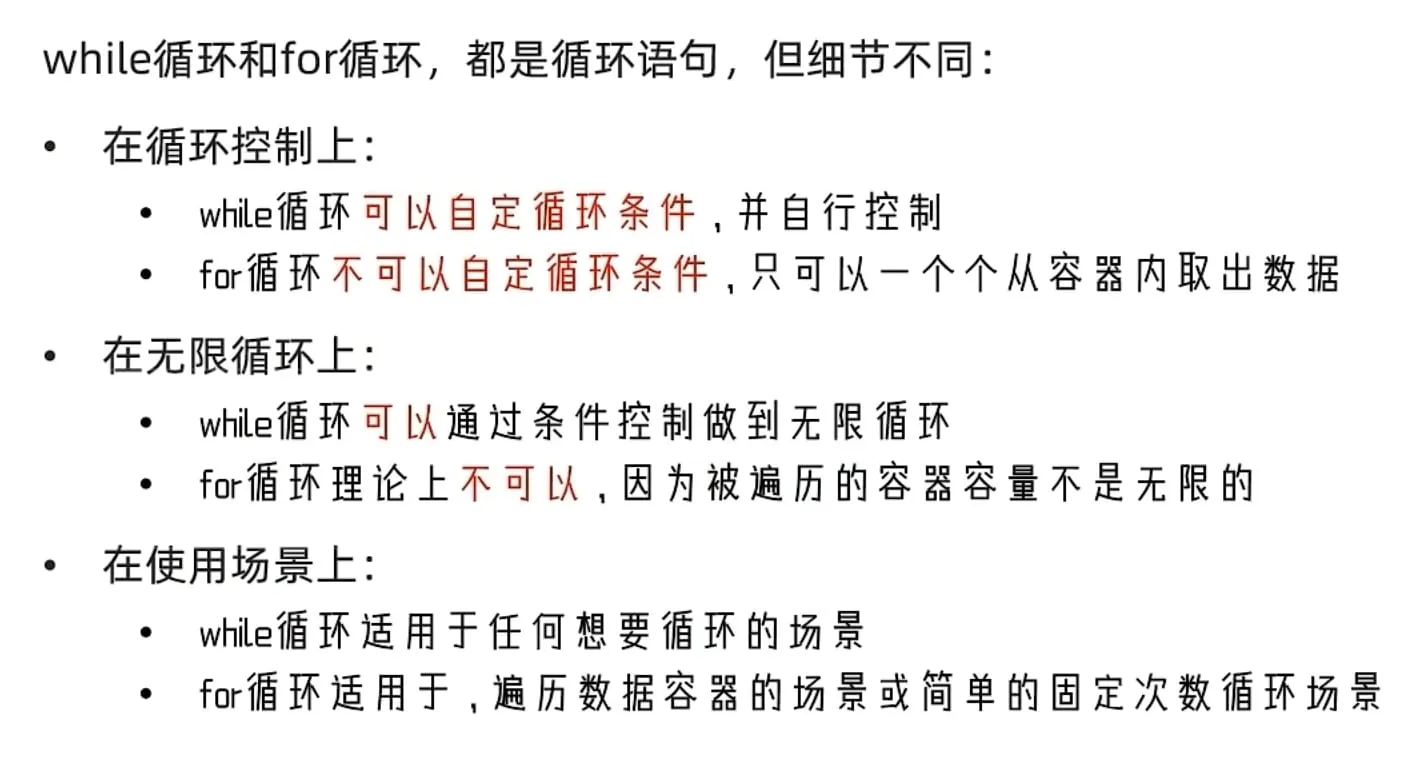
语法: for 临时变量 in 待处理数据集 : 循环体 for 循环是每次从数据集中依次取一个值赋给临时变量,然后执行循环体 -----常用来遍历
例如:
name = "abcdefg"
for Name in name:
    print("%s "%Name,end='' )
output : a b c d e f g求 name 里面有多少个特定字母:
name = "ahdiqwndpwahdalwdjawoidhaoiwd"
ans = 0
for x in name:
    if x == 'a':
       ans += 1
print(ans)for 循环的 range 语句:#
待数据处理集严格来说是序列类型,即序列内容可以被依次取出值的变量类型,包括:字符串、List、tuple range 顾名思义,就是限定一个范围,告诉 for 循环从哪开始到哪结束 定义:def new(cls, __start: SupportsIndex, __stop: SupportsIndex, __step: SupportsIndex = …) -> Self: … 即存在三个参数:开头、结尾、步长 --- start 、 end、 step, 注意:这个相当于数组,输出的最后一个是 arr[end -1] 如果只写一个参数,默认为结尾(保证 range 区间有限);开头默认为字符串首位或者 0;步长默认为 1,即逐个遍历
对于 integer: range(2)表示从 0 开始到 1 结束,即 C++中的 for(int i = 0; i < 2; i++), range(1,4,1)表示从 1 开始到 3 结束,步长为 1
例子:打印九九乘法表
for i in range(1,10):# 即 range(1,9,1)
    for j in range(1,i+1):# 相当于C++中的for(int i = 1;i < i+1; i++)
        print("%d * %d = %d\t"%(j,i,i*j),end='')
    j = 1
print()continue and break#
continue 用于结束当前这一轮的循环,但并未退出循环体; break 则是直接退出循环体
嵌套循环时,continue 就是退出 continue 所在层的循环体,break 和 continue 一样